
A novelty print is the easiest line in a tablecloth catalogue to buy badly. There is no colour standard to anchor it and no holiday date to say when it must ship. Two suppliers both send a “cow print” sample and the samples are not the same product: one motif is four inches across on bright white, the other nine inches on cream. What decides a novelty print is motif scale, ground colour, ink coverage and film gauge, in that order.


A novelty print is sold by motif, not by calendar
Checkered, floral and colour-block ranges are built on a colour system: choose the pair or the bloom and the print follows. A novelty print is built on a subject. The buyer is choosing a cow, a paw or a rainbow because the party has a theme and the table has to announce it.
So the motif becomes the SKU identity and has to be referenced by an approved proof number rather than a name. The print has no seasonal anchor, so it stays on the shelf all year and only the assortment rotates. And the ground colour still decides how it reads on a shelf, in a listing and at the party.
The five novelty families we run
Our printed range groups into five families. A range built from one print each looks deeper than it is; a range built from four versions of one idea looks thin.
| Family | Prints in our range | Ground | Typical use |
|---|---|---|---|
| Animal | Cow patterned, dog claw, brown rugby | White, brown | Farm, pet and kids’ themes |
| Fantasy | Green unicorn, starry sky | Green, dark blue | Birthday, sleepover, backdrop |
| Colour block | Rainbow, colourful balloon | White | General birthday, school events |
| Food and drink | Birthday cake, juice, white fruit | White | Dessert tables, café pop-ups |
| Occasion | Graduation party, black and white birthday | White, black | Milestones with a year or words on them |
Animal prints date fastest when the artwork is a trend rather than an animal. Fantasy prints run on light or deep grounds and are the ones most often reused as backdrops. Colour-block and food prints sit beside any other colour, which makes them the safest first SKUs. Occasion prints have a short window.


Motif scale has to be decided before the artwork
Every sheet we run is 54 by 108 inches, or 137 by 274 centimetres. A four-inch motif appears twenty-seven times across the length; a twelve-inch motif appears nine times. At two metres, roughly how a guest sees the table, the small motif reads as texture and the large one as a picture. Approve a small-scale proof and receive a large-scale print, and you have a different product from the same file.
Two cropping rules decide whether the print survives the table. Motifs crossing the 54-inch edge are folded down the side, so half the motif disappears; if a motif has to sit visibly at the edge, specify an inset or a border. On a 6 ft table the cloth drops about 18 inches at each end, on an 8 ft table only about 6, so a long table shows more of the centre of the design.
Photoreal or flat graphic: two different print problems
A photograph is converted to halftone dots, and dot gain on thin cast film closes the shadows first: the dark parts of a cow hide turn solid before the highlights lose anything. The detail limit at 0.03 mm is coarser than most artwork files assume, which is why a photo print usually needs heavier film rather than more colours.
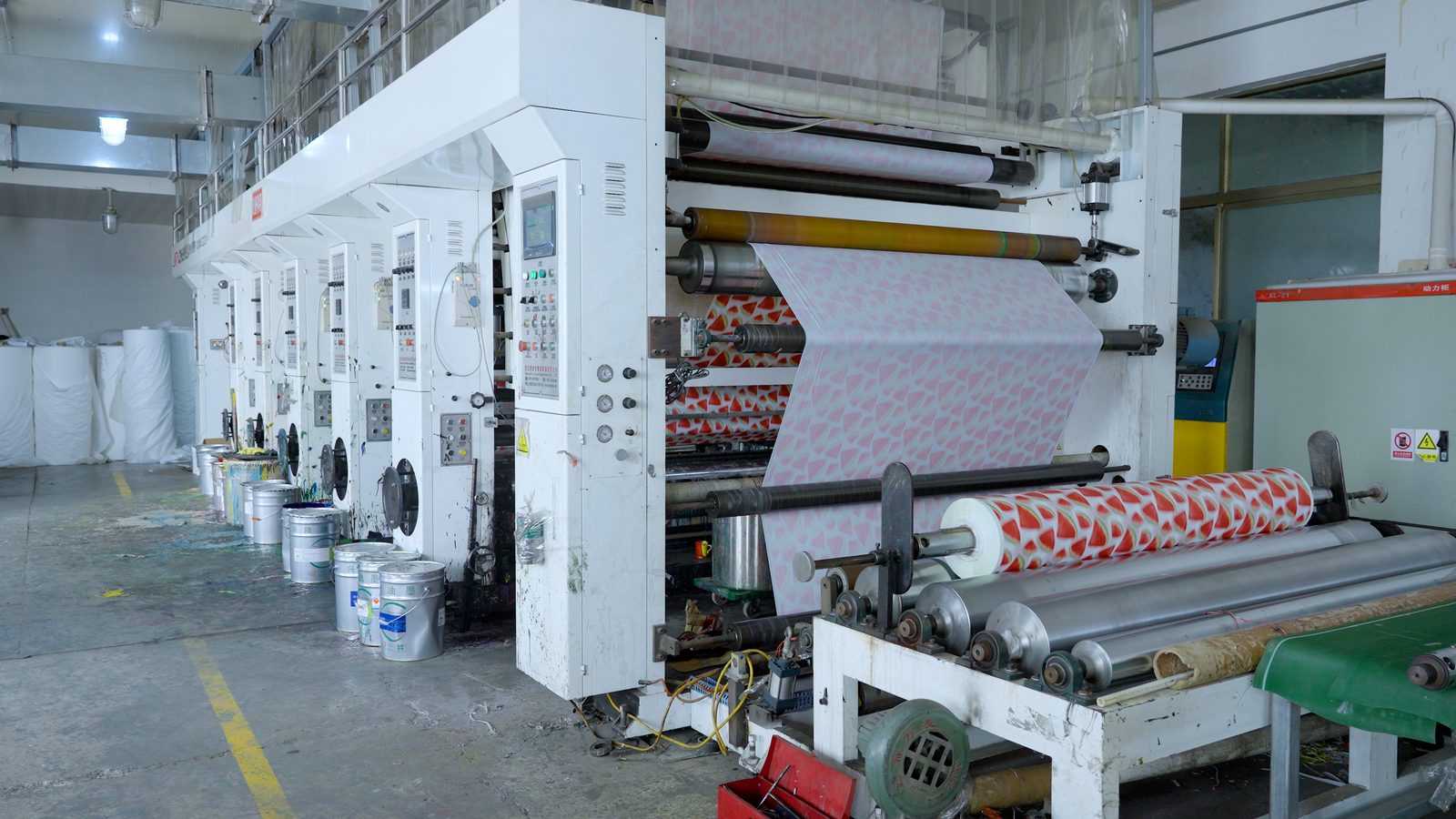
A flat graphic holds cleanly at 0.03 mm and needs two to four stations, and it fails through register drift rather than dot gain: on a flexographic press every extra colour is another chance for the motif to step out of alignment.
Ground colour decides more than the motif
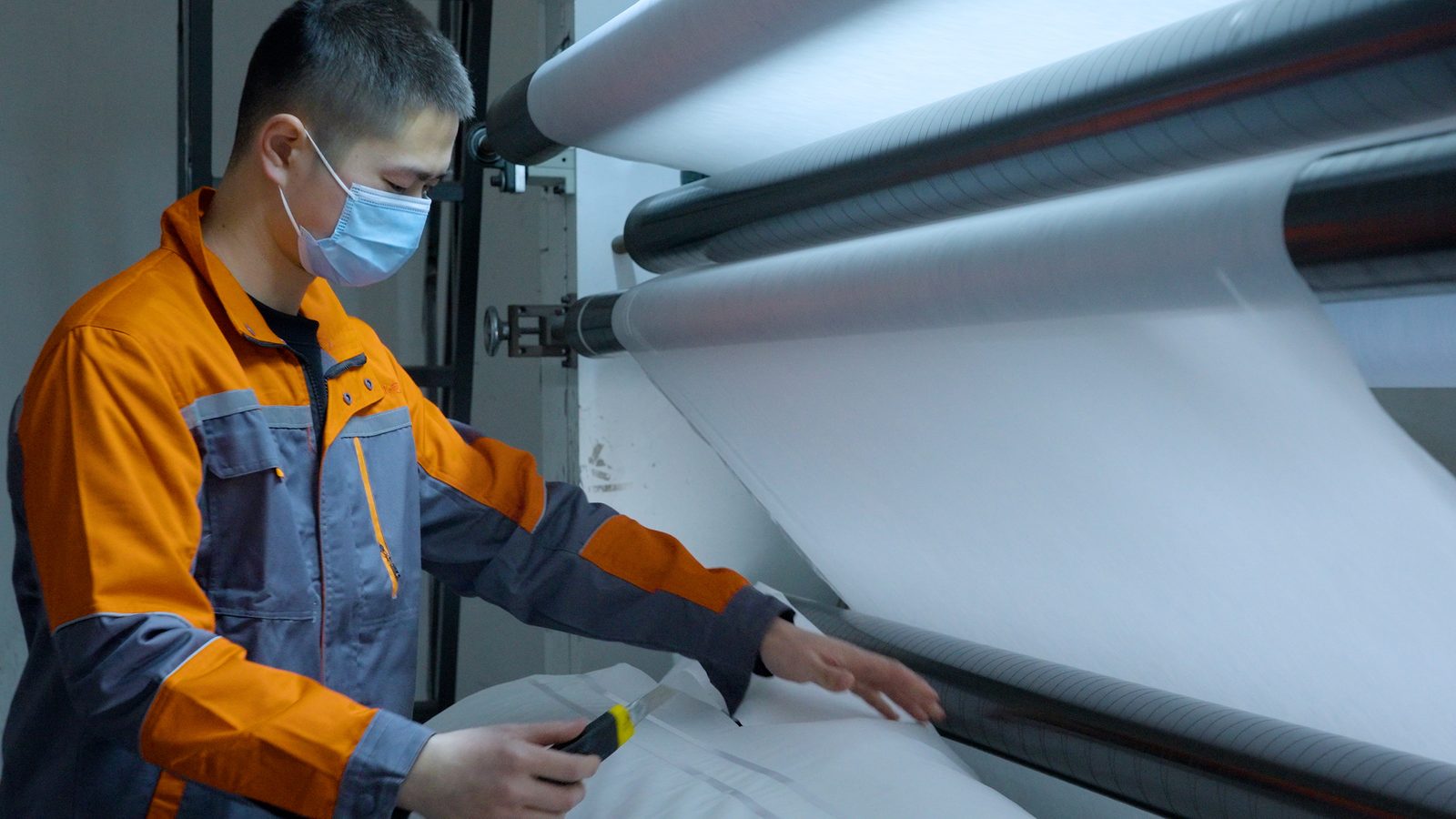
On our film the white is unprinted film, not white ink, so a cream-ground sample and a bright-white one are a resin decision rather than a print decision, and the difference shifts every colour laid on top. Dark grounds hide what is underneath but show every crease, fold line and scuff; a black ground with a light motif is the least forgiving combination we run.
Keep a master sample per print, agree the light it is judged under, and put a tolerance on the colour difference so a reorder can be measured instead of argued about — the method is the same one in our colour specification guide.
Gauge and format: 0.03 mm or 0.05 mm
Both gauges run at 54 by 108 inches: 0.03 mm at about 87 grams per sheet, 0.05 mm at about 150 grams. Both are food-contact polyethylene film specified under 21 CFR 177.1520, with print colourants covered by 21 CFR 178.3297; those two documents are what a compliance pack should quote. Thin film suits flat graphics in three or four colours. Heavy film suits photo prints, dense coverage on a dark ground, cloths that will be reused, and anything that has to hang as a backdrop.
Backdrops change the format too. One sheet covers one table; a wall or photo corner is a continuous run, which is what the roll widths and cuts guide covers: 40-inch and 54-inch rolls at 100 and 300 feet, printed for continuity. A print that appears on both a sheet and a roll should be approved as one job, or the grounds will not match.
How many novelty prints belong in a range
The temptation is to buy breadth, and the result is a wall of near-duplicates: two cow prints from two suppliers, three rainbows in different colour temperatures. A workable shape is one hero print per theme, two supporting prints on the same ground, and a rule that the same motif never enters the range twice from two sources.
Name the SKUs so a reorder cannot drift: family, ground, motif and scale in the code — animal, white, cow, 4-inch — tells the factory and the buyer the same thing without opening a file. The same discipline for grids is in the checkered specification guide. Rotate occasion prints twice a year, animals and fantasy once a year.

The order sheet and five first-carton checks
A novelty print order needs nine lines: approved proof number, ground colour, motif size in inches, repeat type, number of print colours, film gauge, sheet or roll format, packing configuration, and vector artwork with a repeat tile. Leave one out and the factory fills it with its own default, which is where the surprise comes from.
Five checks on the first carton catch almost everything: compare motif size against the approved proof at the agreed light, not just the artwork; compare the ground with the master sample; check register at the tightest part of the motif; tape-test for ink rub; and fold the cloth where it will travel to see the print at the crease. Most field failures trace back to one of these five, as the complaints guide sets out.
Frequently asked questions about novelty prints
Are novelty prints seasonal?
No. The theme is the season. A cow print or a rainbow sells all year; only graduation and dated occasion prints have a window.
Can we order a custom novelty print?
Yes, on 54 by 108 sheets or on rolls. Send vector artwork with a repeat tile; the design is proved on film before production, and the plate or cylinder fee is charged per design rather than per colourway, as in the custom print and artwork approval guide.
Which gauge should a photo print use?
0.05 mm in most cases. Heavy coverage on thin film closes the shadows and shows creases; flat two- to four-colour graphics hold at 0.03 mm.
Do novelty prints come as rolls?
Yes, in 40-inch and 54-inch widths at 100 and 300 feet, printed for continuity so a backdrop does not restart every sheet.
How do we check colour drift on a reorder?
Against a retained master sample, under an agreed light, with a measured colour difference and a stated tolerance.
Next step. Send the motif reference, ground colour and motif size and we will quote the sheet or roll format that fits the table you are covering — contact the factory, or read how we quote before you send the brief.
Related reading. print layout: repeats and panels · floral and lace prints · printed birthday tablecloths · printed tablecloth range