
A baby shower is planned from a colour card, not from a theme aisle. The cake table and the gift table end up in every photograph the family keeps, which is why a shower fails differently from a birthday: rarely too little decoration, usually too many colours in a soft room. The fix is unglamorous — two pastel tints and white, one print at most, and a cover sized to the job each table does.
Start with the palette, not the print
A shower holds together on two tints plus white. Three tints read as a children’s party, four read as a colour-sample card, and saturated primaries built for a five-year-old’s birthday will overpower a room done in cream, sage and pale wood.
Pastel is also the hardest family to judge from a paper swatch. A 0.5 mil film is thin and slightly glossy, so the pink that looks dusty on card looks sweeter on the table, and again under warm hotel light. Before a range is signed off, drape a cover in the actual film over a table and look at it in the light the venue uses. The colour-difference and master-sample method is set out in our colour specification guide.
The pastel tints we run
Our PEVA range carries more than fifty colours; the shower end is what buyers reorder most: pink, light blue, light yellow, sage green, turquoise, lilac, beige, silver grey and white. Standard size is 54 x 108 in at 25 g/m², with custom sizes and shades made to an approved master sample.

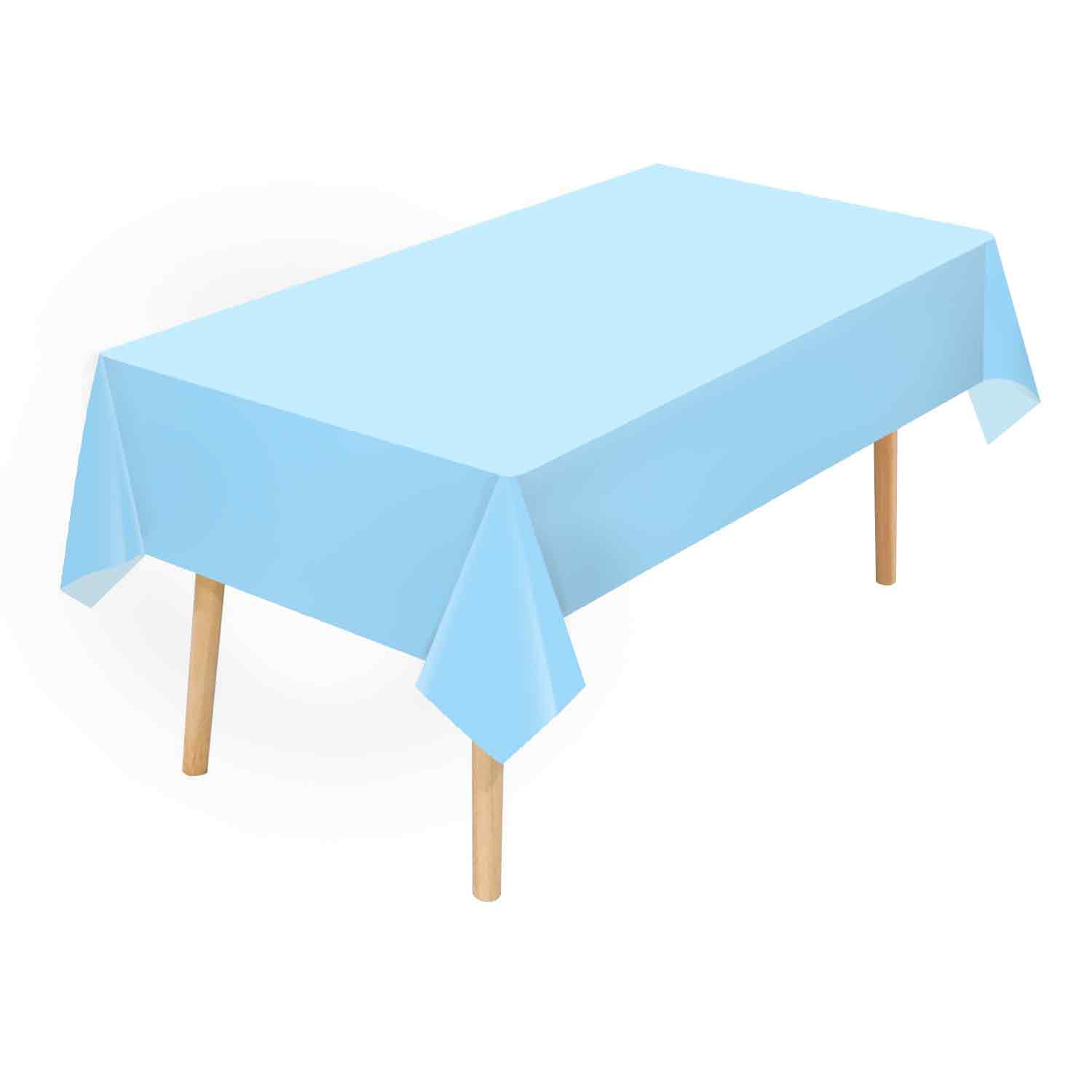

Paired, they cover almost every brief without a new print: pink with white, light blue with white, sage with beige, turquoise with silver grey. The library sits in the solid colour tablecloth range, and a two-tint scheme usually ships from stock shades rather than a custom run.
Autumn showers are a separate palette: orange, cream and sage hold the season without tipping into Halloween. Keep the pumpkin motif on napkins or a runner and put a solid cover underneath.
Prints that survive a soft room
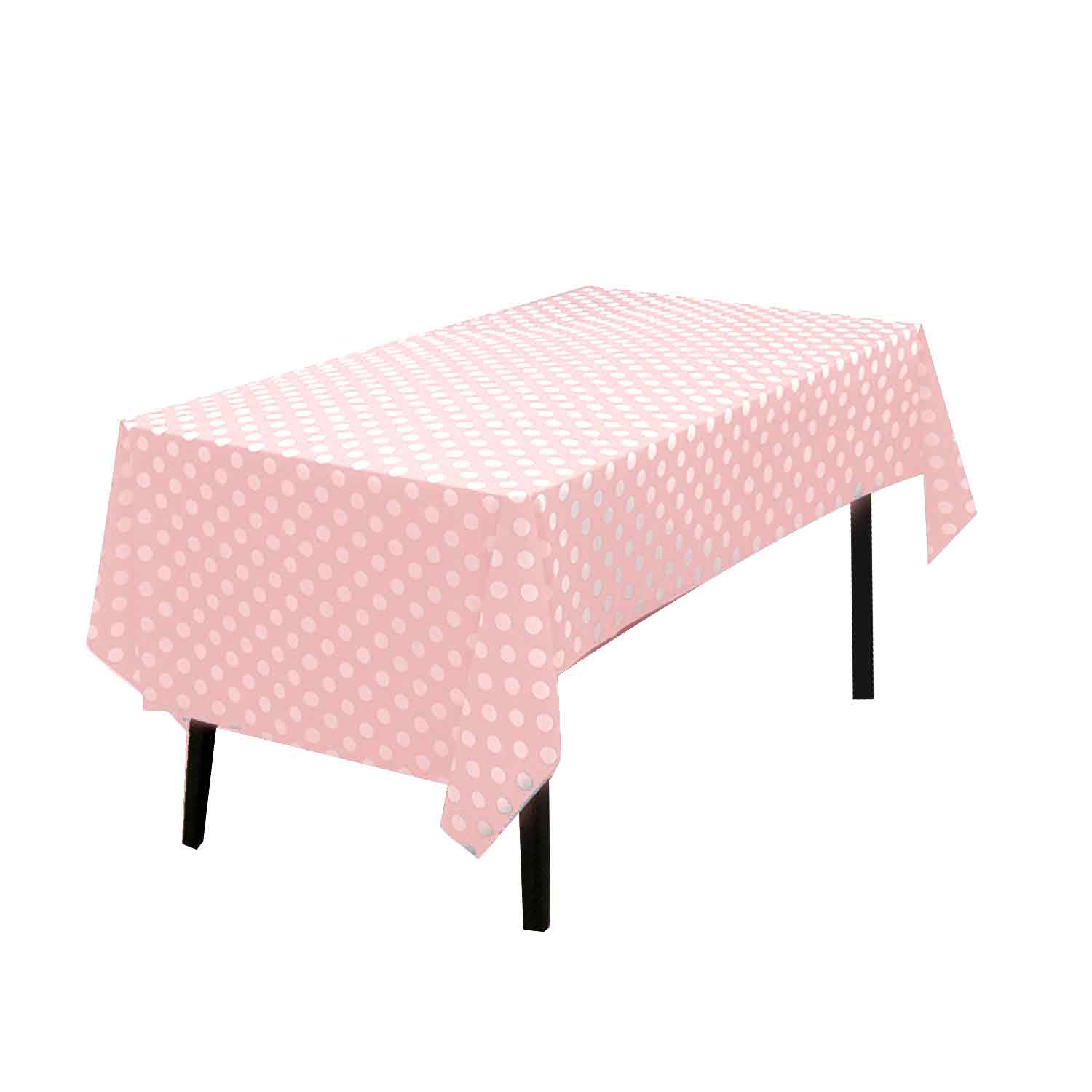


If the host wants a print, one is the limit. Polka dots carry a scheme when the dot is small and the ground is a tint rather than white — a half-inch dot at even spacing reads as texture across the room, a one-inch dot becomes the theme. A balloon print does the same for a shower with a balloon arch; starry sky and printed lace work where the room already has flowers and fabric.
In a printed tablecloth the white areas are usually unprinted film, not white ink, so a white-ground print is the truest white and the cheapest to run; a print on a coloured ground has to cover the tint. Fix motif scale against the 54 x 108 in cover before artwork approval — see dot size and colour and the floral and lace guide.


Three palettes: pink, light blue, neutral
Reveal parties and second-child showers increasingly run neutral on purpose. In practice three schemes cover the market: pink with white, light blue with white, and sage with beige and white — the neutral set that also resells for spring weddings and Easter.
Two rules keep a reveal scheme from looking cheap. Keep the two tints on separate tables rather than splitting one cover into two colours, because a half-pink, half-blue cloth cannot be reused. And do not rely on the cloth to carry the colour story: napkins, plates and cups in the same tint do more work, because they appear at every place setting.
Size each cover to the table’s job
The drop, not the table size, is what makes a shower table look finished. Six to eight inches is casual, twelve to fifteen is banquet, 29 to 30 reaches the floor. The full chart is in the tablecloth size chart; this is the shower set.
| Table | Cover | What it is for |
|---|---|---|
| 4 ft folding table (48 x 30 in) | 54 x 108 in | Gift table, 12 in at the sides when centred |
| 48 in round | 70 in round | Cake table, about 11 in drop |
| 60 in round | 84 in round | Guest table, 12 in drop |
| 72 in round | 96 in round | Large guest table, 12 in drop |
| 6 ft folding table (72 x 30 in) | 54 x 108 in | Food or drinks line, 12 in sides, 18 in at each end |
| 8 ft folding table (96 x 30 in) | 60 x 120 in | Buffet line, 12 in sides |
Do not push a pastel cover to floor length unless the floor is clean: a pale drop picks up scuffs that black hides. A 12 to 15 inch drop photographs better and needs no pinning. Round-table arithmetic is in the diameter and drop guide.
Film weight: what 45 g and 88 g per cover mean
Two covers can look identical on a sample table and behave completely differently. A 54 x 108 in cover runs about 45 g at 0.5 mil, about 88 g at 1.0 mil, and heavier at 1.2 to 1.5 mil. The light band is single-service: fine for an hour of photographs, unforgiving if a chair is dragged across the drop. The middle band — roughly 18 to 25 microns, 16 to 23 g/m² — is the retail and catering standard. The heavy band is what a venue reuses between seatings.
Pastels make this visible: creases from a tight fold, scuffs and gauge variation show more on a pale tint than on black, so check a sample from the production carton rather than the sample room. Band-by-band detail is in the film thickness guide.
Matching the tint across the set
Shower programmes come apart here. The cloth is glossy PEVA, the napkins are 2-ply paper in 6.5 x 6.5 in luncheon or 13 x 13 in dinner size, the plates are rigid PS in 7 or 9 in, and each material renders the same colour number differently. Under tungsten the napkin and the film can look like two tints and under daylight they snap back together — metamerism, which is why the comparison belongs under a stated light source against a physical master sample, not on a screen.
Accept the nearest match inside each material family instead of demanding an exact one, and keep the tightest match where two items sit closest — the napkin on the plate, not the plate on the cloth. Base resins and colorants are covered by 21 CFR 177.1350 for the PEVA film, 21 CFR 177.1640 for PS plates and cups, and 21 CFR 178.3297 for colourants. Cross-material matching is covered in the party set colour guide.
The order sheet and the first carton
Ten fields close the loop: colour name plus master sample reference, cover size, film weight in microns and g/m² plus grams per piece, format, print motif and repeat with ground colour, packing, cartons per pallet and label, artwork approval date, ship window, destination.
When the first carton lands, check five things before the rest ships: the drop is even at both ends when centred, the print registers and holds colour under daylight, a corner survives a fold-and-pull, carton counts and labels match the order sheet, and the tint matches the approved master sample rather than the digital file.
Frequently asked questions
What size tablecloth do I need for a 6 ft shower table?
54 x 108 in. On a 72 x 30 in folding table that gives a 12 in drop at each side and 18 in at each end when centred.
Can a shower cloth be printed with a name or a date?
Yes, on a custom run, but artwork must be approved against a physical proof before production and the date must be final at that point. For a one-off event, a plain cover with printed napkins is lower risk.
Do pastel cloths show creases more than dark ones?
Yes. Pale tints reveal fold lines, scuffs and gauge variation that black hides. Ask for flat-packed covers and check a sample from the production carton.
Is PEVA suitable for a table that food is served from?
The film is made for table use, and the base resin and colorants fall under 21 CFR 177.1350 and 21 CFR 178.3297. Ware that touches food directly should be rigid PS specified under 21 CFR 177.1640.
Should the cake table and the guest tables match?
They should share the palette, not the print. One tint on the cake and gift tables, the second on guest tables, and white as the bridge.
Next step. Send us your table list and the two tints you are considering, and we will come back with a cover size per table and a film weight per cover — see how we quote or contact the factory. Related reading: printed birthday tablecloths, in case the same range also has to cover children’s parties.